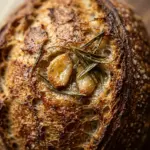
Ingredients
Scale
- 500g Bread Flour (high protein)
- 350g Warm Water
- 100g Active Sourdough Starter (fed and bubbly)
- 10g Sea Salt
- 1 head of Roasted Garlic (cloves mashed)
- 2 tablespoons Fresh Rosemary, finely chopped
- Extra flour for dusting
Instructions
- In a large mixing bowl, whisk together your warm water and active sourdough starter until the starter is mostly dissolved. Add the bread flour and salt. Mix by hand or with a sturdy spoon until a shaggy dough forms and no dry flour remains. Cover the bowl with a damp cloth and let it rest for 30 minutes to allow for autolyse.
- After the rest period, spread the mashed roasted garlic and chopped rosemary over the top of the dough. Gently fold the dough over itself several times to begin incorporating the ingredients. You don’t need to perfectly mix them yet, as the stretch-and-fold process will distribute them evenly.
- Cover the bowl and let the dough rise in a warm spot. Over the next 2 to 3 hours, perform four sets of “stretch and folds” every 30 minutes. To do this, grab one side of the dough, pull it upward, and fold it over the center. Rotate the bowl and repeat four times. This builds strength in the dough and incorporates the garlic and rosemary thoroughly.
- After the final set of folds, let the dough sit undisturbed in a warm place until it has grown in size by about 50% and looks bubbly and jiggly. This usually takes 4 to 6 hours depending on the temperature of your kitchen.
- Gently turn the dough onto a lightly floured surface. Fold the edges toward the center to create tension and shape it into a round boule or oval batard. Place the dough upside down into a well-floured proofing basket (banneton). Cover and place in the refrigerator for 12 to 15 hours. This cold proof develops the flavor and makes the dough easier to score.
- Preheat your oven to 450°F (230°C) with a Dutch oven inside for at least 45 minutes. Carefully flip the cold dough onto a piece of parchment paper. Use a sharp blade or lame to score a deep slash across the top. Carefully lower the dough into the hot Dutch oven, cover with the lid, and bake for 20 minutes. Remove the lid and bake for another 20 to 25 minutes until the crust is deeply browned and the internal temperature reaches 205°F.
- Cook Time: 18 hours 45 minutes